

June 4, 2026
Automation Direct in 2026: A Practical Workflow Guide for SaaS Buyers
Automation direct only works when teams map ownership, state, exceptions, data, and support paths before wiring tools together. This guide explains how to buy and implement it pragmatically.
Automation direct sounds simple until the first support ticket says the customer was emailed twice, the CRM says the deal is closed, finance never saw the invoice, and nobody knows which system made the decision.
That is where small business teams usually discover the gap between “we automated it” and “the workflow is reliable.” The UI looked clean. The demo looked fast. The template worked once. Then real data, real exceptions, and real ownership showed up.
Teams think the problem is manual work. The real problem is unmanaged handoffs between tools, people, approvals, and records. Automation direct is not just connecting App A to App B. It is deciding where work should move automatically, where humans should intervene, and which system is allowed to be trusted.
That changes the conversation. Instead of asking “Which tool has the most automations?” the practical question is: “Can this software move work directly through our operating model without creating hidden cleanup work?”
Table of contents
- What automation direct really means in SaaS workflows
- Map the workflow before you automate direct
- Choose where automation direct should live
- Design the data model before connecting tools
- Build an automation direct workflow in sequence
- Compare automation direct tools by operating model
- Common failure modes when teams automate direct
- What works in production
- What fails in production
- Build governance without slowing everyone down
- Make automation direct a software decision, not a feature chase
What automation direct really means in SaaS workflows

Automation direct is useful only when it removes a handoff without removing accountability. That distinction matters. A direct automation that creates a task, updates a record, sends a message, and moves a customer into the next status is not automatically good. It is good only if the next person, system, or customer receives the right state at the right time.
It is not a button that says automate
Most SaaS tools now include automation builders, AI actions, workflow templates, conditional triggers, and integration marketplaces. That does not mean the business has automation discipline.
The mistake teams make is treating automation as a feature inside each app. Marketing automates email follow-up. Sales automates CRM updates. Support automates ticket routing. Finance automates invoice reminders. Each team may be correct locally, but the customer journey can still be messy globally.
A useful way to think about it is this: automation direct is a workflow contract. It says, “When this condition is true, this action happens, this record changes, this owner is notified, and this exception path catches anything unsafe.”
Practical rule: Do not automate an action until you can explain who owns the result when the automation is wrong.
Direct means fewer handoffs between systems
The word “direct” should not mean “reckless.” It means fewer unnecessary manual relays. If a qualified lead is ready for sales, the system should not depend on somebody exporting a spreadsheet every Friday. If a customer submits a cancellation reason, the account owner should not need to copy it into three tools.
Direct automation works best when the path is predictable:
- A form submission creates or updates a known record.
- A status change triggers one downstream action.
- A payment event changes access rights.
- A support tag routes work to the right queue.
- A project milestone creates a review task.
What breaks in practice is ambiguity. If two systems both believe they own customer status, the automation becomes a negotiation between databases.
Why this matters in 2026
In 2026, small teams are under pressure to do more with fewer tools, fewer meetings, and less manual coordination. AI has increased expectations, but it has also increased noise. Many teams can generate content, messages, summaries, and tasks faster than they can verify whether the work should happen.
That is why automation direct is now a buying decision, not just an operations preference. Buyers need to know whether software supports clear triggers, reliable integrations, audit trails, retries, permissions, and exception handling. Productivity is not the number of automations created. Productivity is the amount of trusted work that moves without supervision.
Related reading from our network: content teams face the same problem when publishing systems move faster than review processes, which is why this guide to AI blog publishing software workflow architecture is a useful adjacent example.
Map the workflow before you automate direct
Before choosing software, draw the workflow. Not the ideal version. The actual version. Include the workarounds, Slack messages, spreadsheets, approvals, and “ask Sam before sending” steps.
Start with the trigger, event, and owner
Every automation starts with a trigger, but the trigger is not enough. You need the event and the owner.
A trigger is what the software detects. An event is what the business believes happened. An owner is the person accountable if the business interpretation is wrong.
For example:
- Trigger: deal stage changed to “Closed Won.”
- Event: customer is ready for onboarding.
- Owner: sales operations or the account executive.
Those are different things. A rep can accidentally move a deal stage. A contract can be signed but payment not collected. A customer can be “won” but not technically ready for setup. If the automation direct path treats the trigger as the whole truth, downstream teams inherit bad state.
Separate routine paths from exceptions
Do not design for every edge case first. That creates paralysis. But do not ignore exceptions either. Good workflow design separates routine automation from exception handling.
Routine path:
- Known input.
- Clear owner.
- Validated record.
- Low-risk action.
- Reversible outcome.
Exception path:
- Missing data.
- Conflicting records.
- High-value account.
- Compliance-sensitive action.
- Customer-facing message with uncertain context.
Practical rule: Automate the routine path directly, but route uncertain work into a visible review queue.
This keeps speed without pretending the software understands every business nuance.
Document state, not just tasks
A task says what someone should do. State says what is true right now. Automation direct depends on state.
Bad documentation says:
- “Send welcome email.”
- “Create onboarding task.”
- “Notify finance.”
Better documentation says:
- Customer status: active pending onboarding.
- Contract status: signed.
- Payment status: awaiting first invoice.
- Access status: not provisioned.
- Onboarding owner: unassigned.
State-based workflows are easier to test because the automation can check conditions before acting. Task-based workflows often become notification chains with no reliable source of truth.
If your team is also choosing broader planning tools, the same workflow-first lens applies to project management software in 2026: ownership and operating rhythm matter more than feature volume.
Choose where automation direct should live
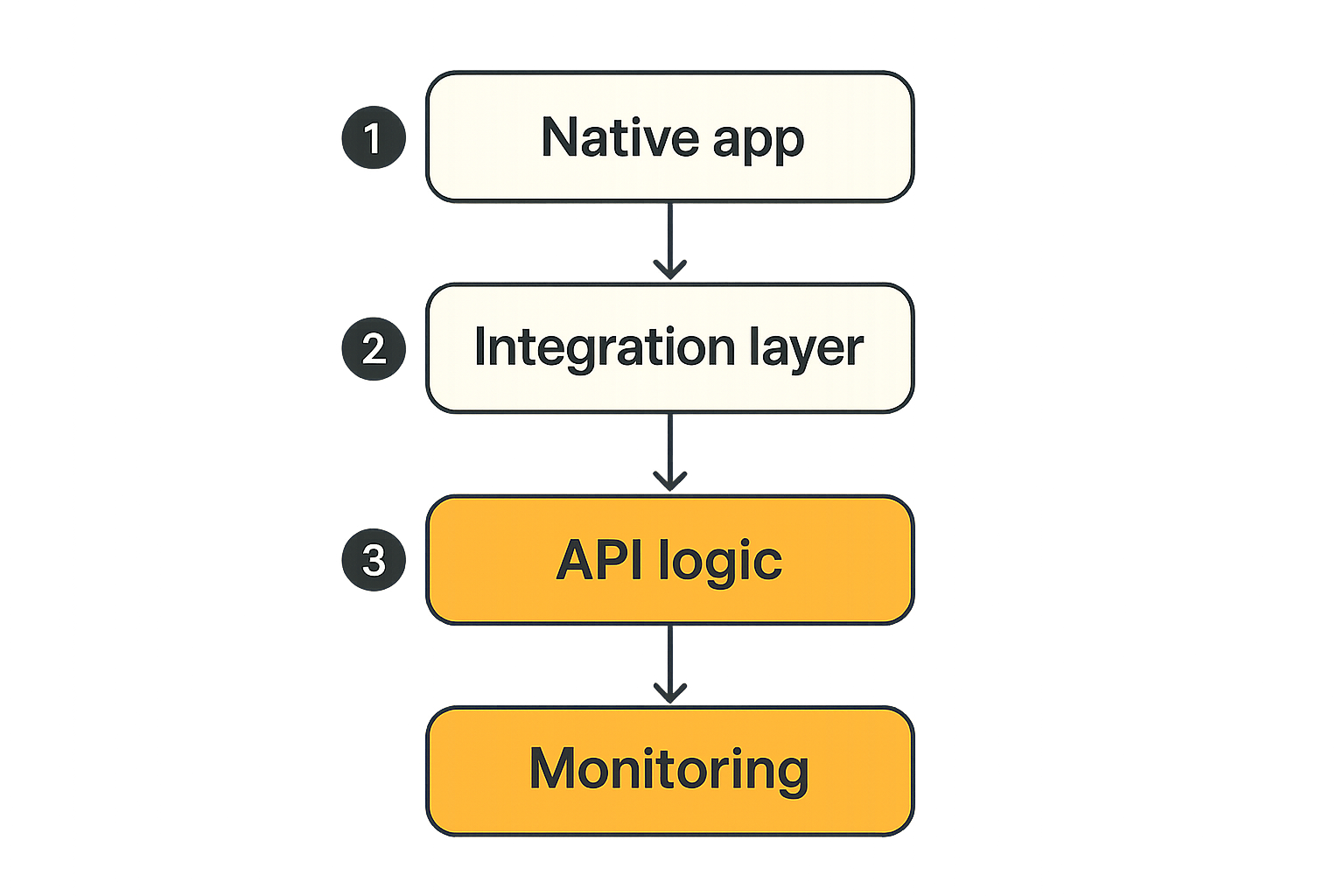
Not every automation belongs in the same place. One of the highest-leverage architecture decisions is where the workflow logic should live: inside a native SaaS app, inside an integration platform, or in custom code.
Native app automation
Native automation is usually the fastest place to start. A CRM can assign leads. A help desk can route tickets. A billing platform can send reminders. A project tool can create tasks from templates.
This works when the workflow is mostly contained inside one product. It also works when the vendor has deep domain logic, such as subscription billing, support SLAs, or approval routing.
The tradeoff is portability. Native automations can become hard to inspect across tools. If marketing, sales, and support each build separate rules in separate apps, nobody sees the whole workflow.
Use native automation when:
- One app owns most of the process.
- The rules are simple and low risk.
- The vendor provides strong logs and testing.
- The automation is easy for non-technical owners to maintain.
Integration platform automation
Integration platforms are useful when the workflow crosses multiple systems. They can connect forms, CRMs, spreadsheets, communication tools, finance apps, and databases without writing custom code.
The practical question is whether the integration platform becomes a reliable workflow layer or just another hidden place where fragile rules live.
Look for:
- Idempotency or duplicate prevention.
- Retry behavior and failure queues.
- Clear run history.
- Environment separation for testing.
- Permissions that do not require one shared super-admin account.
Related reading from our network: product teams working across launch assets, approvals, and distribution have similar handoff issues, and this piece on AI content product launch workflow shows the same operating pattern in a different context.
Custom API or script automation
Custom automation makes sense when the workflow is valuable, specific, and sensitive enough to justify engineering ownership. It is not automatically better. It is just more controllable.
Use custom code when:
- You need strict validation before action.
- You need to combine multiple data sources.
- You need version control and formal review.
- You need stronger observability than no-code tools provide.
- A failed automation creates financial, legal, or customer trust risk.
The mistake teams make is jumping to custom code because no-code feels “less serious.” In many small businesses, the opposite is true. A well-owned no-code automation with logs and alerts is better than a script only one contractor understands.
Design the data model before connecting tools
Automation direct is only as reliable as the data it moves. If customer names, account IDs, lifecycle stages, product plans, and owner fields are inconsistent, automation will amplify the inconsistency.
Define the source of truth
For every critical object, define the system of record.
Common examples:
- Customer account: CRM or customer database.
- Subscription status: billing platform.
- Support conversation: help desk.
- Product usage: analytics or product database.
- Project delivery status: project management tool.
Avoid “dual truth” unless you have a deliberate sync strategy. If the CRM says a customer is active and billing says the subscription is past due, which one should automation believe? That decision must be made before the workflow runs.
Normalize fields and IDs
Names are not identifiers. Email addresses change. Company names have punctuation, subsidiaries, and duplicates. If tools can share stable IDs, use them.
At minimum, standardize:
- Account ID.
- Contact ID.
- Subscription ID.
- Ticket ID.
- Deal ID.
- Project ID.
Also standardize lifecycle fields. “Active,” “Live,” “Customer,” and “Onboarded” may mean different things in different tools. Automation direct needs one controlled vocabulary or a mapping layer that translates states consistently.
Treat permissions as workflow data
Permissions are not an IT afterthought. They determine what automation can see and do.
A workflow that requires broad admin permissions to update one field is a risk. A workflow that runs under a departed employee’s account is an incident waiting to happen. A workflow that can send customer-facing messages without approval needs extra scrutiny.
Practical rule: Use service accounts or dedicated automation identities where possible, and review their access like you review employee access.
Permissions should match the action. Read-only data enrichment does not need the same access as account cancellation, invoice adjustment, or user provisioning.
Build an automation direct workflow in sequence
This is where many teams skip ahead. They buy a tool, connect apps, and start turning on rules. It feels productive for a week. Then someone asks why 400 old contacts received a new onboarding email.
A practical implementation sequence
Use a controlled rollout. It does not need to be bureaucratic. It needs to be observable.
- Name the workflow. Example: “Qualified lead to sales assignment.”
- Define the business event. Example: “A lead meets qualification criteria and is ready for rep follow-up.”
- Identify the trigger. Example: form score exceeds threshold and required fields are present.
- Confirm the source of truth. Example: CRM owns lead status.
- Write the success condition. Example: lead has owner, status changed, notification sent once.
- Define exception conditions. Example: missing company email, duplicate account, restricted region.
- Build in test mode. Use sample records or a sandbox if available.
- Run with logging enabled. Review every run during the pilot.
- Roll out to a narrow segment. Start with one team, one region, or one product line.
- Assign maintenance ownership. Decide who can change rules and who reviews failures.
Example lead to invoice workflow
A simple B2B workflow might look like this:
- Website form creates lead in CRM.
- CRM checks for duplicate account.
- Qualified lead is assigned to a rep.
- Closed-won deal creates onboarding project.
- Signed order triggers invoice draft.
- Payment confirmation updates customer status.
- Customer receives access and welcome instructions.
The automation direct path is not one automation. It is a chain of state changes. Each link should have a success condition and an exception path.
For teams using AI in content or sales enablement around this funnel, the same discipline applies. A tool should improve the whole workflow, not just generate output faster, which is the core buying point in this guide to AI content SaaS workflow evaluation.
What to test before rollout
Test boring things. Boring things break production.
- Duplicate submissions.
- Missing required fields.
- Old records that match new rules.
- Users without permissions.
- API rate limits.
- Vendor downtime.
- Retries after temporary failures.
- Customer-facing messages with bad personalization.
- Time zones and date fields.
- Manual edits made during automation runs.
If a workflow cannot handle these, keep it in assistive mode. Let it draft, suggest, tag, or queue work before allowing it to take direct action.
Compare automation direct tools by operating model
A software comparison should not start with “Does it have automation?” Nearly every SaaS product does. The better question is “What kind of automation operating model does this tool support?”
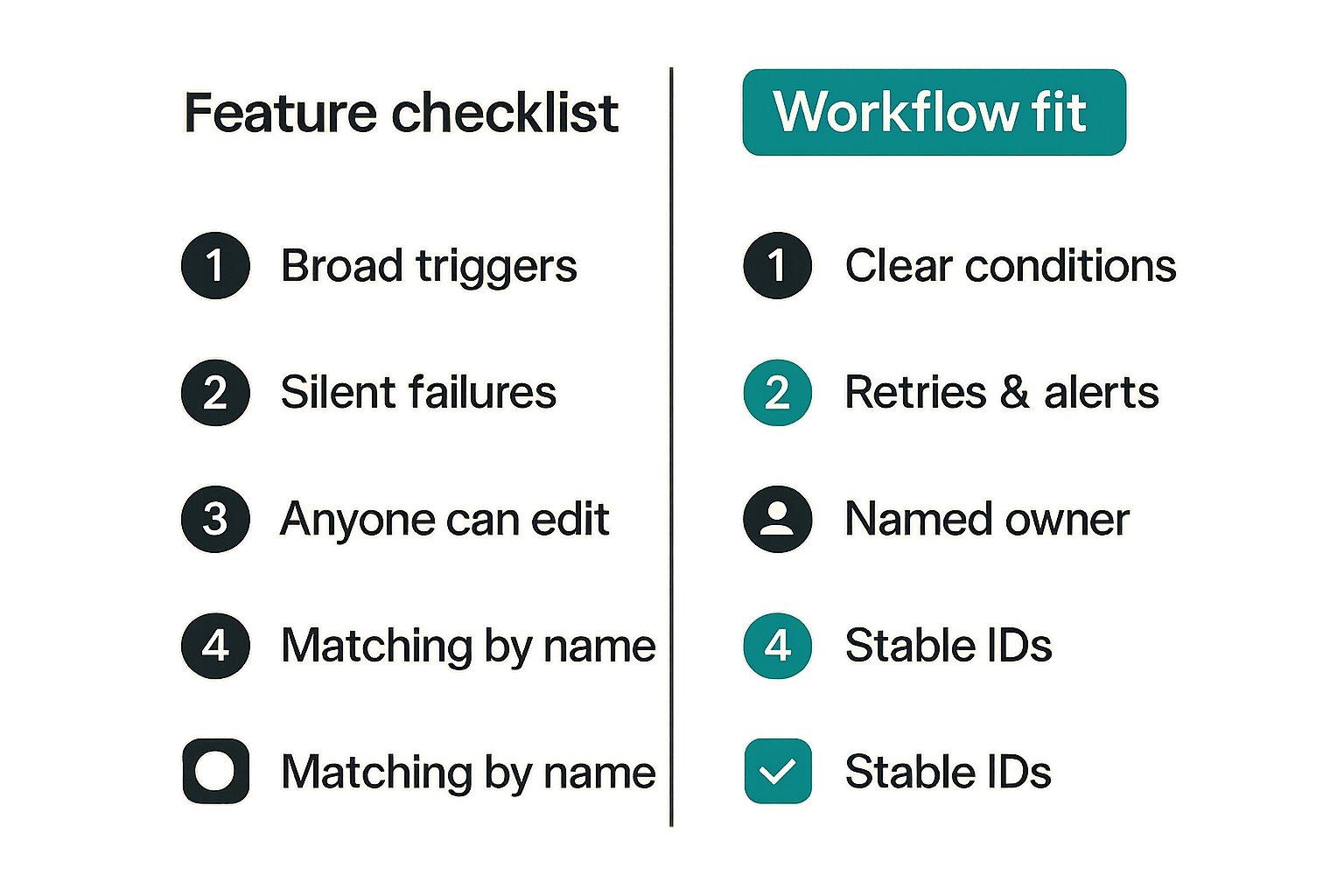
Comparison table for buyers
| Evaluation area | What works | What fails | Buyer question |
|---|---|---|---|
| Trigger design | Clear conditions, filters, and test records | Broad triggers that catch old or irrelevant records | Can we preview affected records before enabling? |
| Error handling | Retries, failure queues, alerts, and logs | Silent failures or vague “something went wrong” messages | Where do failed runs go? |
| Ownership | Named workflow owner and change history | Rules created by anyone with no review | Who can edit production automations? |
| Data model | Stable IDs and controlled fields | Matching by name or free-text status | Which fields are required and validated? |
| Permissions | Scoped automation accounts | Personal admin accounts running workflows | What identity performs the action? |
| Observability | Run history, timestamps, payload visibility | No audit trail | Can we inspect what happened and why? |
| Rollback | Disable switch, versioning, manual repair path | No way to undo bulk actions | How do we recover from a bad rule? |
Questions vendors should answer
When evaluating software, ask practical questions:
- Can automations be tested against sample data before activation?
- Are automation runs logged with inputs and outputs?
- Can failures trigger alerts to a shared inbox or channel?
- Can rules be exported, versioned, or documented?
- Does the platform support conditional branching?
- How are duplicate events handled?
- What happens during API downtime?
- Can permissions be scoped by role?
- Does the vendor expose webhooks or APIs for advanced workflows?
A confident vendor should answer without turning the conversation into a demo of shiny templates.
When cheaper tools become expensive
Low-cost automation tools are attractive, especially for small teams. They can be the right choice. But cheap becomes expensive when the team pays in cleanup hours, customer confusion, and lost trust.
The hidden cost usually appears in three places:
- Manual reconciliation after silent failures.
- Support tickets caused by wrong messages or duplicate actions.
- Dependency on one person who understands the automation maze.
The practical question is not “What is the monthly subscription?” It is “What happens when this workflow fails at 9 p.m. before a customer renewal?”
Common failure modes when teams automate direct
Bad automation rarely fails dramatically on day one. It usually degrades quietly. Records drift. Notifications multiply. People stop trusting the system and go back to side channels.
Silent failures and lost work
Silent failures are the most dangerous because they look like productivity. The team believes work is moving, but the automation stopped at step three.
Examples:
- A webhook fails and no task is created.
- A CRM field changes name and routing breaks.
- An API token expires.
- A contact is skipped because one required field is blank.
- A billing event arrives before the customer record exists.
The fix is not more meetings. The fix is visible failure handling. Every important workflow needs a place where exceptions land and a person responsible for clearing them.
Looping notifications and duplicate records
Loops happen when two systems listen to each other without a clear source of truth. System A updates System B. System B sees an update and changes System A. Then both systems believe they are being helpful.
Duplicates happen when matching logic is weak. If the automation matches on company name, “Acme Inc.” and “ACME Incorporated” may become two accounts. If it matches on email, shared inboxes can create bad merges.
Prevent this with stable IDs, event deduplication, and rules that distinguish between human edits and automation edits.
Automating a broken approval process
Automation direct does not fix unclear authority. If nobody knows who can approve a discount, an automated discount request will simply move confusion faster.
The same applies to hiring, procurement, customer escalation, content approval, refund approval, and access provisioning. Before automation, define the decision rights:
- Who can approve?
- What conditions require approval?
- What is auto-approved?
- What must be logged?
- What requires customer communication?
Related reading from our network: even in software supply-chain workflows, the same principle applies; this article on CI/CD supply chain security workflow risk is a technical but relevant example of mapping changes before trusting automation.
What works in production
Production automation should be boring, visible, and maintainable. If it feels clever, it may be too fragile.
Keep humans in exception lanes
The goal is not to remove people from the workflow. The goal is to stop making people babysit routine work.
A good production pattern is:
- Automation handles predictable cases.
- Humans review exceptions.
- The system records decisions.
- Future automation improves based on repeated exception patterns.
This is how teams avoid the false choice between manual control and blind automation. You keep judgment where it matters and remove repetitive forwarding where it does not.
Use logs, alerts, and review queues
Logs are not just for engineers. Operators need them too. A sales ops manager should be able to see why a lead was assigned. A support lead should be able to see why a ticket escalated. A finance owner should be able to see why an invoice reminder was sent.
Minimum operational visibility:
- Workflow name.
- Trigger timestamp.
- Record affected.
- Action taken.
- Actor or automation identity.
- Success or failure status.
- Error message.
- Link to retry or review.
If the tool cannot show this, keep the automation low-risk.
Measure cycle time and rework
Do not measure automation by counting rules. Measure operational improvement.
Useful metrics include:
- Time from lead capture to owner assignment.
- Time from closed-won to onboarding kickoff.
- Time from ticket creation to correct queue.
- Percentage of automation runs requiring manual repair.
- Duplicate record rate.
- Customer messages corrected or resent.
- Number of exception items aging past SLA.
The point is not to create a dashboard nobody reads. The point is to know whether automation direct is actually reducing work or just moving it into cleanup.
What fails in production
Most automation failures are not caused by bad intentions. They are caused by optimistic assumptions.
Feature checklist buying
Buying from a checklist creates shallow comparisons. “Has workflow automation” tells you almost nothing. The tool might support only basic triggers. It might have no run history. It might not support branching. It might require admin privileges for every action.
A better buying scorecard includes:
- Workflow fit.
- Data ownership.
- Integration depth.
- Error handling.
- Permission model.
- Reporting and auditability.
- Maintenance burden.
The mistake teams make is overvaluing what is easy to demo and undervaluing what is painful to operate.
One owner for every app but none for the workflow
You can have a CRM owner, help desk owner, billing owner, and project tool owner and still have nobody owning the customer handoff between them.
That is where workflows break. Each app is configured correctly from its own perspective, but no one owns the end-to-end path.
Assign workflow ownership for critical paths:
- Lead to opportunity.
- Opportunity to onboarding.
- Onboarding to active customer.
- Support escalation to product feedback.
- Renewal risk to account action.
- Cancellation request to retention or closure.
This does not require a new department. It requires a named person who can convene the app owners and make decisions.
No rollback path
A bad automation can update hundreds or thousands of records quickly. If the team has no rollback path, the cleanup becomes manual and error-prone.
Before enabling high-volume automation, define:
- How to pause the workflow.
- How to identify affected records.
- How to reverse common actions.
- Who communicates with customers if needed.
- Who signs off after repair.
Rollback is not pessimism. It is operational maturity.
Build governance without slowing everyone down
Governance does not have to mean ticket queues for every small change. It means the team can move fast without losing track of what changed and why.
Naming conventions and change control
Name workflows so humans can understand them later. “Automation 17” is not a system. Use names like:
crm_lead_assign_inbound_demo_requestsupport_escalate_enterprise_sla_breachbilling_update_access_payment_failedonboarding_create_project_closed_won
For change control, keep it lightweight:
- Document purpose.
- Document trigger.
- Document owner.
- Document downstream systems.
- Record last changed date.
- Record rollback notes.
Small teams can keep this in a shared doc or project tool. Larger teams may need formal workflow inventory.
Access reviews and audit trails
Review automation access quarterly or after major team changes. Remove automations owned by departed users. Rotate tokens where appropriate. Check whether rules still match the business process.
Audit trails matter when customers ask why something happened. They also matter internally when teams debug disputes between systems.
A useful audit trail answers:
- What triggered the workflow?
- What data was used?
- What action was taken?
- Which identity performed it?
- Was the action retried?
- Was a human involved?
If a vendor cannot support this for critical workflows, that should affect the buying decision.
AI automation boundaries
AI adds a new layer. It can classify, summarize, draft, route, and recommend. It can also hallucinate, overgeneralize, or act on incomplete context.
For AI-assisted automation, separate recommendation from execution.
Lower-risk AI actions:
- Summarize a support thread.
- Suggest a category.
- Draft an internal note.
- Recommend next steps.
- Identify missing fields.
Higher-risk AI actions:
- Send customer-facing messages automatically.
- Approve refunds.
- Change account status.
- Modify billing.
- Grant or revoke access.
For high-risk actions, keep human approval until the workflow has enough evidence, monitoring, and rollback capability.
For support and self-service workflows, knowledge quality becomes part of the automation system. If your automation depends on help content, this guide to Zendesk knowledge base software workflows explains why ownership, analytics, and maintenance matter.
Make automation direct a software decision, not a feature chase
Automation direct should make the business calmer. Fewer status meetings. Fewer “did this get done?” messages. Fewer duplicate records. Faster customer response. Cleaner handoffs between tools.
But that only happens when the team treats automation as architecture. The software needs to fit the workflow, the workflow needs clear state, and the owners need visibility into failures.
Where saasrow.com fits
saasrow.com is for readers who want practical articles, guides, and insights about software and productivity. That means looking past feature pages and asking how tools behave in real operating environments.
When comparing automation platforms, CRM workflows, help desk tools, AI productivity software, or project management systems, use the same lens:
- What work moves directly?
- What state changes?
- Who owns exceptions?
- What integrations are required?
- What happens when the tool fails?
- Can the team maintain it without heroics?
The closing point is simple: automation direct is valuable when it reduces handoffs without hiding responsibility. If a tool cannot make that clear, keep asking questions before you buy.
Try saasrow.com
You are writing for readers who want practical articles, guides, and insights about software and productivity. For more grounded software guides, Try saasrow.com.